Showing posts with label Bengali Literature. Show all posts

Sunday, July 4, 2010

Death's Grief by Rabindranath Tagore

Translated by Bhaswati Ghosh

Note: Recently, I lost a loved one to cancer. Though not born into our family, the person had become family for us, and the death only showed me how attached I had been, without ever realizing that when the person was around. As I grappled with this loss, almost unable to accept the reality of it, I turned to Tagore for some solace. The piece below, part of Tagore's autobiography, reflects how he himself felt the depth of grief following his sister-in-law's death, and how his heart finally found acceptance and even peace. Worked as a balm for me in these difficult moments.

That there could be any gap anywhere in life wasn’t known to me at that time; everything seemed tightly knit within laughter and tears. Nothing could be seen beyond that, hence I had received that as the ultimate truth. Suddenly, when death emerged out of nowhere and, within a moment, created a hole in the middle of this very manifest life, my mind was totally puzzled. All around me, trees, land, water, the sun, the moon, the stars, and the planets firmly continued to be as they were, yet that, which amid them was just as true as themselves—in fact, which, the body, this life, the heart had, through a thousand touches, known to be even truer than all these supernal entities—when that loved one dissolved like a dream within no time, it seemed to be an utter collapse of the self! How could I reconcile what remained with what was no more!

A darkness emerging from this pit attracted me all the while. I kept circling and returned to the same spot, looked at that same darkness and searched for something in place of what had been lost. Humans can never entirely believe in nothingness. Whatever isn’t there is untrue, and whatever is untrue isn’t there. That is why the effort to see within what can’t be seen and the search for acquiring that which can’t be had never stops. Just like a sapling, if bound inside a dark fencing, keeps growing upright on its toes in a desperate attempt to get past the darkness and raise its head in light, all my heart and soul, when suddenly fenced by a ‘not there’ by death, desperately kept trying to come out to the light of ‘is there’ within that boundary. There’s no greater misery than to realize that the path to cross that darkness isn’t visible within that darkness.

However, in the middle of this despairing grief, a breeze of happiness would flow in my heart every now and then, taking me by surprise. The sad fact that life is not absolutely and inertly definite lifted a load off my chest. I felt joyous thinking that we aren’t imprisoned within the stone walls of unmoving truth. That which I had held on to had to be let go of. When seen from the perspective of loss, this evoked pain, but when I saw it from the angle of freedom, I felt spacious peace. That day, I, for the first time realized like a strange truth, that this world’s enormous weight balances itself with the give-and-take of life and death and flows in every direction thus; that weight won’t crush anyone with suppression—no one would have to bear the tyranny of a sole master called life.

This apathy made nature’s beauty even more deeply exquisite for me. For some days, my blind attachment to life nearly disappeared—trees swaying against bright skies would rain a burst of delight down my tear-washed eyes. Death had brought about the distance necessary for viewing the world with completeness and beauty. Standing detached, I watched the world’s image on the vast backdrop of death and knew it to be beautiful.

For a while at that time, a carefree attitude took over my heart, which was also reflected in my outward actions. I found it laughable to conform to the society’s courtesies by considering them to be a great truth. All that wouldn’t touch me at all. For a few days, I was completely oblivious to who thought what of me. I would just drape a thick shawl over my dhoti and wear a pair of chappals to go to Thacker’s shop for buying books. My meals were also characterized by haphazardness. For some time, my bed, even during rains and winters, remained on the balcony of the second story; there, I could see the stars eye to eye and meet the light of the dawn without any delay.


Not that any of these was an austerity for practicing detachment. This was more like a holiday for me. When I found the cane-wielding teacher of this world to be a deception, I ventured to taste freedom by trespassing even small controls. If one fine morning one woke up and found out that the earth’s gravitational pull had lightened by half, why would one want to carefully tread the official path? One would, most definitely, wish to jump across the four-five storied houses on Harrison Road, and if, while enjoying the breeze in Maidan, one came across a monument, one wouldn’t even want to walk past it, but rather to leap over it. My condition was similar—the moment the pull of life loosened under my feet, I was eager to completely leave the beaten path.

On the terrace of our house, alone at night, I would run my fingers like a blind man all over the night, in hopes of seeing a flag atop any peak in the domain of death or a letter or even some symbol etched on its black stone gates. Then, the next morning when light filled my bedding on the balcony, I would open my eyes and find the covering of my heart clearing away; I would find that the expansive view of life appeared as dew-fresh new and marvelous to my eyes as the way in which the world’s rivers, mountains and forests dazzle with the lifting of a fog.

Photo courtesy: Forest Poetry

Tuesday, January 27, 2009

Pagol or Madman by Rabindranath Tagore

Translated by Bhaswati Ghosh

A small town in the west. At an end of the big street, five or six palm trees rise above the thatched roofs like a mute man's signs to the sky. Next to the derelict house, an ancient tamarind tree puffs up its dense, glistening foliage like clumps of green cloud. Young goats move about on the ground of this roof-less house. Behind them, the lushness of the forest range spreads across the horizon of the afternoon sky.

Today, rain has completely withdrawn its dark cloak off this town’s head.

I have a lot of important things to write—those remain unwritten. I know this would be a cause of regret in the future; let that be; I would have to accept that. One can never know or stay prepared for the moment when or the form in which wholeness emerges, but when it does, one can't welcome it empty-handed. At that moment, the one who discusses loss and gain must be a smart calculator and would do well in the world; but dear vacation of light in the midst of glum ashadh (1), in front of your momentary bright, cloud-less glimpse, I put to dust all my important activities—today, I won't make calculations about the future—I am sold off to the present.

One day follows another, none of them demands anything of me; the calculations don’t go wrong then, all work happens smoothly. In such times, life progresses by linking one day to the next, one task to another; everything is uniform. Suddenly, when a special day appears without informing, like a prince from across the seas; a day unlike any other, all the trail of the days past is lost in an instant—that day, it becomes difficult for routine work to proceed.

This day, though, is our big day—this day of irregularity, this day of ruining work. The day that comes and defeats our everyday is our day of joy. The other days are for the intelligent, the careful, and this one day is for giving ourselves completely up to madness.

Mad isn’t a hateful word to us. We worship Nimai (2) because of his craziness; Maheshwar (3) too is our lunatic god. The West is debating as to whether talent is only a form of developed craziness—but here, we don’t feel ashamed to accept this as true. Inspiration is, of course, craziness, it is an exception to the rule, it comes only to upset order—it emerges all of a sudden—like today’s haphazard day—and destroys all the work of working people—some curse it, some others go crazy, dancing and delighting with it.

Bholanath (4), who remains as the joyful one in our scriptures, is one such oddity among all deities. I see that mad lord amidst the flood of sunshine shining through this day’s washed blue sky. His tabour plays steadily within the heart of this thick afternoon. Today, death’s naked pure face stands still in the middle of this work-filled world—with beauty and peace.

Bholanath, I know you are strange. In every moment of life, you have appeared with your begging bag. And completely wrecked all calculations and measurements. I am familiar with your Nandi (5) and Bhringi (6). I can’t say that they haven’t given me a drop of your intoxicating beverage; these drops have inebriated me, everything has been upset—today nothing is in order for me.

I know that happiness is an everyday item, but bliss is beyond every day. Happiness remains constricted, fearing it may get dirty; bliss rolls over dust and shatters its separation with the universe; that is why to happiness, dust is inferior, but for bliss, dust is an ornament. Happiness is afraid of losing something; bliss is delighted to relinquish everything; for this reason, to happiness, emptiness is poverty, but to bliss, poverty is abundance. Happiness carefully protects its grace within the confines of order; bliss openly expresses its beauty in the freedom of destruction; this is why happiness is bound to outward rules, but bliss breaks those bounds to create its own rules. Happiness waits for nectar to arrive; bliss drinks the poison of sorrow with ease. For this reason, happiness is partial to only good, but for bliss, good and bad are no different.

There’s a madman in all of this creation who brings in everything that is inconceivable for no reason at all. He is the centrifugal force who is forever pulling the universe outside rules. The god of rule is always trying to put all the world’s paths into a neat orbit, and this madman overturns all this and twists it into a coil. At his whim, this madman creates bird in the clan of snakes and man in the family of apes. There’s a desperate attempt in the world to permanently protect all that has happened and all that is; he plunders all of that to carve paths for what is not yet there. His hands don’t hold a flute, harmony isn’t his tune; his pinak (7) rumbles, all orderly yagna (8) is ruined, and out of nowhere, something wonderful appears on the scene. Craziness and talent, both are his creations. The one whose string breaks at his pull goes mad, and the one whose string plays in an unheard melody becomes gifted. Mad people are outside the range of the ordinary, and so it is with talented people. The mad, however, remains on the fringe only, while the gifted take ordinary people into a new realm, thereby increasing their rights…


It is not as if this mad lord of ours appears only at certain moments; in creation, his madness is always at work; we only get a glimpse of it in certain moments. Death is forever making life new, bad is brightening good, and the inconceivable is giving value to the trifle. At the moment we get such a glimpse, the freedom within the form becomes evident to us.

Today, amid this cloudless light, I see that amazing face. That road across, that thatched-roof provisions store, that broken house, that narrow by-lane, those trees and vegetation—I used to see all these with the pettiness of everyday familiarity. That’s why these had confined me—had kept me in house arrest within these daily images. Today, all of a sudden, all the pettiness is gone. On this day I see that for so long I had been viewing the unknown as familiar; my seeing wasn’t clear at all. Today, I can’t finish looking at all these. Today, all of these things surround me, yet they don’t imprison me, they all make way for me. My madman was here only—that spectacular, unknown wonder, who did not ignore this thatched-roof provisions store—only, I didn’t have the light before my eyes with which to view him. What is amazing about today is that these nearby images have acquired for me the glory of a far-off place. The impenetrability of the snow-capped Himalayas and the impassability of the wave-ridden ocean express their fraternity with the madman.

In this way, one day we suddenly realise that the one with whom we had established a familial relationship remains outside our family. The one whom we had taken to be readily available in every moment is actually rare and hard to get. Those, around whom we had drawn a boundary thinking we knew them well, appear to have acquired a marvellous mystery by crossing all boundaries. The same one who, when viewed from the side of rules and balance, appeared rather small, quite regular, very familiar, when viewed from the side of breach, from the angle of that graveyard-roaming madman, turns me speechless—amazing! Who is that! The one whom I have always known is now this, who! The one who is part of the home on one side belongs to the heart on the other. The one who is important to work on the one hand is completely outside all necessities on the other. The same one whom I touch on the one hand is, on the other, beyond all grasp. The one who has managed to fit well with everyone is, at the same time, a total misfit, absorbed in self.

Today I saw the one whom I don’t see every day. In so doing, I gained freedom from every day. I thought I was bound by the everyday rules within the fence of familiarity surrounding me. Today I see, I have been forever playing on the lap of grand wonder. I thought that I had been making my daily calculations under the sharp gaze of a big officer in the office. Today, at the roaring laughter of the miscalculating madman—who is bigger than the big officer—reverberating through water, land, sky, air and the entire universe, I heave a sigh of relief. My workbook remains untouched. I lay down the pile of my important work at the feet of that capricious madman—let the blow of his Tandava (9) smash it into pieces and blow it off as dust.

1. Ashadh: A month of the Hindu calendar

2. Nimai: A prominent saint of medieval Bengal and the founder of Bengal Vaishnavism. Also known as Chaitanya Mahaprabhu.


3. Maheshwar: Another name for Shiva, a major Hindu deity. The god of destruction.


4. Bholanath: Alternative name for Shiva.


5. Nandi: Shiva's vehicle, a bull.


6. Bhringi: Originally a demon who was transformed by Shiva into a humble devotee and admitted into his force as a commander of his armies.


7. Pinak: Shiva's bow.


8. Yagna: A Hindu ritual, dating back to Vedic times, carried out to please gods. Oblations are poured into sacrificial fire, as everything that is offered into the fire is believed to reach the gods.


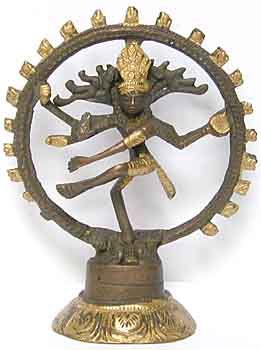
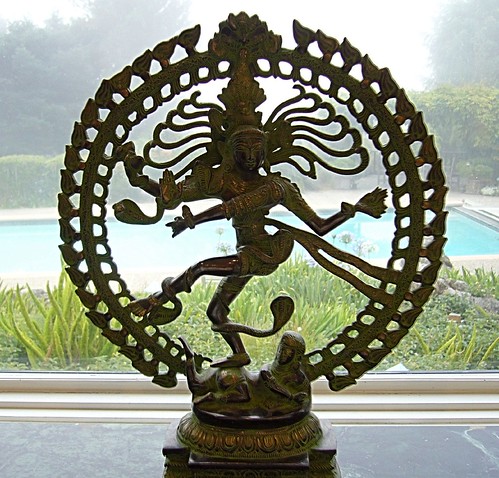
9. Tandava: In Hindu mythology, Shiva’s Tandava is a vigorous dance that is the source of the cycle of creation, preservation and dissolution.

Friday, July 20, 2007

On a Cloudy Day by Rabindranath Tagore

Every day is filled with work and with people all around. Every day one gets the feeling that the day’s work and exchanges finish saying all that needed to be said at the end of the day. One doesn’t find the time to grasp that which remains unsaid within.

This morning, cluster upon cluster of cloud has covered the sky’s chest. Today, too, there’s work to do, and there are people around. But there’s a feeling that all that lies inside cannot be exhausted outside.

Man crossed seas, scaled mountains, dug holes under the ground to steal gems and riches, but transmitting one person’s innermost thoughts and feelings to another—this, man could never accomplish.


On this cloudy morning that caged thought of mine is desperately flapping its wings within me. The person inside says, “Where is that forever’s friend who will rob me of all my rain by exhausting my heart’s clouds?”

On this cloud-covered morning I hear the inside voice rattling the closed door’s fetters again and again. I wonder what should I do? Who is the one at whose call my words will cross work’s barrier to journey through the world with the lamp of song in my hands? Who is there whose one look would string all my strewn pain into a garland of joy, and would make them glow in one light? I can only give it to the one who begs it of me with the perfect note. At the bend of which road stands that ruinous beggar of mine?

My inside’s ache is wearing a saffron robe today. It wants to come outside, into the path which, like the innocent single string of an ektara, chimes within the steps of the ‘heart’s person.’

Translated by Bhaswati Ghosh


Thursday, May 24, 2007

The End of Cold War (Short Story) -- Part II

By Subodh Ghosh

Read Part I


The college hasn’t closed; neither have the train times changed. The five past ten arrives and leaves every day. Mr. Ticket Checker checks passengers’ tickets near the gate in the same fashion. A month has passed; yet the colored sari’s border isn’t seen waving along the gate.

Nevertheless, Bhagyalakshmi and Ashirbad still face each other with the same ferocity, standing in opposite rows. Nitai inhales his tobacco slowly; Ramcharan chews on his roasted grams without a blink. Neither passes even a slight smile at the other. There is still no exchange of words between them.

Passengers come in so many types. Bhagyalakshmi and Ashirbad, too, ferry tons of travelers. From station to market, market to town. However, this labor is nothing more than mere labor. Bhagyalakshmi and Ashirbad’s horns boom out of sheer habit. The blare doesn’t rouse with the joy of a victory song.

As usual, the five past ten train arrives at the station. It’s late by ten minutes. The swarming crowd of passengers rushes in through the gate. And…Nitai’s eyes light up. Ramcharan’s face quavers. Both rickshaws—Bhagyalakshmi and Ashirbad suddenly shiver. A colored figure is seen to excitedly bypass Mr. Checker, and is seen heading this way.

The tinted face can be identified even through the gaps in the thick crowd. That girl. Nitai gets a firm grip on his cycle’s handle. Ramcharan strikes his seat to shake off the dust and lifts a restless foot on the paddle. The horns of Bhagyalakshmi and Ashirbad blow desperately.

Within moments, a puzzling blow starts to dampen this rush of resentment between the two rickshaws . Bhagyalakshmi’s horn sobs; Ashirbad’s quivers like a cracked throat.

The girl’s appearance has changed. A vermillion strip colors her hair’s parting; there is a veil on her head. She isn’t wearing those small earrings any longer. A huge pair of kanpashas adorns her ears. The girl isn’t alone. There’s someone with her. A young man. He is donning a silk shirt and a Farasganga dhoti. New shoes in the feet. Three rings on the fingers.

The man holds the girl’s hand. He smiles and so does she. Both come this way. Suddenly, they stop. It is as if they cannot see the two rows of rickshaws on the stand. They don’t even cast a single glance on them—not the girl, not her male escort.

They pause in front of a taxi. Before even a minute passes, Sanatan’s shiny new taxi races away on the road, cutting between the two rows of rickshaws, scattering a cloud of smoke all over the place. The girl has left, along with her male companion.

The smoke and burnt petrol smell coming off Sanatan’s new taxi don't hang heavy in the air for too long either. A gust of wind comes and sways the curtains of Bhagyalakshmi and Ashirbad.

All rickshaws leave with passengers. Pakshiraj, Mon re Aamar, Urboshi, Koto Moja, Joy Ma Kali, Pranaram, Shukh-Shanti, and Chol re Chol. Only Bhagyalakshmi and Ashirbad stand quietly, facing each other.

It’s as if fatigue and lethargy have suddenly gripped both the rickshaws. No resentment, none of that colliding resolve. None of them fidgets.

Ramcharan says, “Hey, Nitai, mind giving me a bidi?”

“Here,” Nitai says.


THE END

Sunday, May 20, 2007

The End of Cold War (Short Story) -- Part I

By Subodh Ghosh

Translated by Bhaswati Ghosh

A mere mention of the station’s name would make it clear to just about anyone which place is being referred to and how far it is from Calcutta.

Rayer Haat station. One needs to travel about a mile from here to reach the city crowds. There’s a market. A look at the market reveals there must be a mid-sized town nearby, a town that has everything. Court, hospital, theater, college. If one stands close to the market, the names of the roads become visible along with their appearances. College Road, Hospital Road and so on. Even from this distance, the advertisement jingle blaring out of the theater loudspeaker can be heard.

Only when a passenger train arrives does the station come to life with an uproar; it’s always quiet otherwise. Forever silent. At most times of day and night, the station’s life droops with a lazy drowsiness. Two big Nagkeshar trees stand on the platform. A peanut seller sleeps under them. When the sharp whistle of a train’s arrival blows, he wakes up with a start.

On crossing the station gate where tickets are checked, one comes across a staircase, which leads to a pebble-strewn area—packed with a few taxis and around ten cycle rickshaws. The clamor reaches its peak when the passengers jostle their way across the narrow gate to land at this open space. The horns of all taxis and rickshaws start blowing together, accompanied with shouts and calls. “Come here, sir…here, Ma…this way, Babu. Three annas for market, four annas for town.”

Taxis call, “Come, come. One rupee to go to the town.”

All the taxis and rickshaws get passengers. There are always a few travelers who prefer to ride the taxi and don’t hesitate to pay a rupee for a mile.

The rickshaws stand in two rows facing each other. This row includes Bhagyalakshmi, Koto Moja, Joy Ma Kali, Pakshiraj, and Mon re Aamar. That row has Chol re Chol, Shukh Shanti, Urboshi, Ashirbad, and Pranaram. Besides, this row’s Bhagyalakshmi and that row’s Ashirbad are always face to face, as if seething with wrath against each other. Bhagyalakshmi’s Nitai slowly smokes his bidi in, his eyes glaring at Ashirbad’s Ramcharan. And Ramcharan chews on roasted grams while glancing at Nitai from the corner of his eye. The other eight rickshaws display no such tussle. Karali, Bhanu, Siddiq, Girdhari and others wonder why such malice exists between Bhagyalakshmi and Ashirbad. No one understands why Nitai throws such nasty glares at Ramcharan. And why does Ramcharan answer back with his lip-biting mean stare either? It’s a mystery.

In terms of income, neither of them lags behind the other. If one of them earns less in a week, he makes up for it in the next. On days when passengers come for taking a dip in the Ganga, Nitai makes a little more money. But the very next week, Ramcharan’s rickshaw draws countless passengers to the fair.

Nitai and Ramcharan are both stout men. It’s difficult to say who would win if both actually engaged in a duel some day. Nitai wears a short shirt and a dhoti. Ramcharan dons a vest and a half pant. They appear to be of the same age as well. Between twenty and twenty-one.

For as long as these two rickshaws stay in their respective rows at the stand, facing each other, both suffer a silent anxiety. Nitai constantly looks toward the station gate. Ramcharan does, too. Passengers swarm in from the gates and scatter near the stand. They approach the rickshaws. But neither Nitai’s nor Ramcharan’s eyes betray any eagerness to grab passengers. Both of them look with great hope at the gate, expecting the arrival of someone special. Perhaps the person would come; yesterday’s arrival was by the five past ten train. Will it be a no show today?

When the ticket checker’s figure moves away from the gate, when the last passenger is seen crossing the gate, both Nitai and Ramcharan sigh with relief. The person hasn’t come. The anxiety contest lulls a bit, and both of them focus on other passengers.


Bhanu, Siddiq, and Girdhari try to figure it out. Nitai and Ramcharan are no strangers to each other. In fact, there used to a time when they were thick pals. Only since the past six months, the two have started getting distanced. Neither even wants to exchange a simple word with the other. Just six months back Bhagyalakshmi and Ashirbad would stand together in the same row. There have been occasions when on seeing Urboshi standing beside Bhagyalakshmi, Ramcharan created a ruckus, pushing Ashirbad next to Bhagyalakshmi. Bhanu would remark “Ah, it’s as if these two are Ram and Lakshman. Can’t stay without one another.”

Not every day, but at least thrice a week, a girl alights at this station from one of the passenger trains. One look at her reveals her background, the reason she comes to the Rayer Haat station on those three days, and the place she intends to reach.

She goes to the town. Carries books. All the rickshaw-wallahs know she studies in the town college.

But where does she come from? Many know that as well. Bhanu says “She comes from Jaigarh. There’s a new township at Jaigarh, near Tribeni.”

The girl comes and goes back alone. In the evening, she would board upon any rickshaw in the town to catch the five fifty train. Urboshi, Pakshiraj, or Mon re Aamar would bring her from the town.

The responsibility to take her from the station to the town, however, rests with only two rickshaws—Bhagyalakshmi and Ashirbad. Nitai clutches the cycle’s handles strong; Ramcharan’s feet get fidgety on the cycle’s paddle. Both blow their horns as if gripped by a fervent resolve.

As soon as she approaches the stand, two rickshaws leap out of the assembly of vehicles. The front wheels of the two rickshaws collide. The clash of the rickshaws blocks the road. The girl can’t move.

Not that she needs to move. Either Bhagyalakshmi or Ashirbad. One of them would speed out of the stand with its horn shaking the quiet air with a victory song and race through the roads. Empty roads. Their sides replete with small bamboo bushes and old shrines. The rickshaw runs past large mango trees, and a world of joy filled with bird chirpings. Market, College Road, College. The rickshaw’s journey stops; either Bhagyalakshmi or Ashirbad.

Bhanu laughs, “Like Nitai, like Ramcharan; both are shameless”

Siddiq consumes his khaini and says with a smile, “Both have gone crazy.”

Indeed, it is as if they have gone mad. Nitai’s sad eyes suggest that when Ramcharan takes the girl on his rickshaw with a pride and crushes Nitai’s soul with the blow of his horn. For a long time, Nitai stands with a still look. As if he has forgotten all his ability to toil and his doggedness to earn money.

The same crazed look takes over Ramcharan’s face, too. When the girl climbs up Bhagyalakshmi. A long plait dangles, on some days it is a wide knot, green slippers, and a colored sari. Sometimes it’s striped, sometimes dotted, sometimes, printed. Bhagyalakshmi races with a breeze; the girl’s earrings shake in a whirl.

The moment Bhagyalakshmi disappears into the shadows of the mango trees, Ramcharan blows the dust off Ashirbad’s seat with a thud and talks to the approaching passenger. “Where will you go? How many people? I won’t take more than two passengers, Moshai.”

Who knows what has happened? It’s been many days, nearly a month. Winter’s chill has given way to spring’s breeze. The mango trees are laden with florets. But where is that girl?

Part II


Image courtesy:
http://www.flickr.com/photos/jackol/838178/


Tuesday, May 8, 2007

Subodh Ghosh: Master of Shorts


Great storytellers often tell stories that can be adapted for big and small screens. Some write with that idea in mind, others just spin the yarns they must. While the unceasing debate on how sincere the moving picture adaptation is to the written work carries on, I have to admit, I came to know quite a few writers via the moving images. Subodh Ghosh is one of them.

As a regular follower of a televised series of short stories by different Bengali writers aired on one of the Bengali channels here, I noticed the stories that particularly drew me had one thing in common—their author. Subodh Ghosh’s stories would prick the psyche for days, even while other stories had an impression life of just a few hours. Thhagini or The Con Girl was the first of these stories. When I saw it, the story stunned me for its original approach to the oft-done theme of deception. In the story, a father-daughter duo lives off deceiving unsuspecting victims. Their trick is simple—they pose as a family facing abject penury, the father unable to wed his very marriageable daughter. They keep changing neighbourhoods, carrying along the same story. In every area, some kind man takes pity to their situation, and the girl gets married, usually to a prosperous man. Within the next couple of days, she smartly flees the place, not without the cash and jewelry she begets as the new bride. This keeps happening, and even as the police are desperate to catch the father and daughter, Sudha, the girl, actually falls prey to the love of her third “husband”. In bittersweet irony, she flees again and deceives again—only this time, she runs with her husband and cheats no one else, but her father.

Although I thought Thhagini was the first Subodh Ghosh story that moved me to read more of his work, it turns out he had made an impression on me long ago. In the form of Ijazat, Gulzar’s sensitive adaptation of Ghosh’s Jatugriha (Lac House). Later, of course I would watch the Bengali screen version of the film directed by Tapan Sinha, starring Uttam Kumar, equally sensitive and closer to the original story. And years before that, the thoughtful Bimal Roy made one of the finest films out of Sujata, a novel by Ghosh of the same name. To date, Sujata, the film, remains one of my favourites for its perceptive handling of the issue of caste prejudice and for Roy’s delicate portrayal of a woman’s emotions.

Not just Tapan Sinha, Bimal Roy, and Gulzar, but even Ritwik Ghatak turned to Subodh Ghosh’s work for one of his films—Ajantrik. As little as I have read of Bengali literature, Subodh Ghosh got my vote, thanks to the wonderful screen adaptations of his stories by these brilliant directors.

As I read through an anthology of Subodh Ghosh stories, I am impressed by the realism, the extraordinary insight into the quirks of human nature and the way they play out in relationships, and one of the best weapons of a writer--a deft touch of irony.


Tuesday, February 20, 2007

Tuntuni and the Cat by Upendrakishore Ray

There’s a brinjal plant in the backyard. Tuntuni has built her nest by stitching the plant’s leaves. Three little fledglings lie in the nest. They are so small they can’t fly or even open their eyes. They just open their mouths and call out “cheen-cheen.”

The family cat is really wicked. She just thinks I shall eat Tuntuni’s fledglings. One day she came near the brinjal plant and said, “What are you doing, dear Tuntuni?”

Tuntuni bowed and leant her head by the branch of the brinjal plant and said, “Salutations, your highness.” The cat went away happily.

She would come every day, Tuntuni would greet her and address her as “Queen” and the cat would go away feeling happy.

Tuntuni’s fledglings have grown up now. They don’t keep their eyes shut anymore. Seeing this, their mother asked them, “My dear ones, can you fly now?”

The little ones said, “Yes, Ma, we can.”

Tuntuni said, “Let’s see if you can hop over to that top branch of that tall Tal tree.”

The fledglings immediately flew over to the top branch. Tuntuni smiled and said, “Let the evil cat come now!”

In a while, the cat walked in and said, “So, what are you up to, Tuntuni?”

Tuntuni gestured a kick at her and said, “Get lost you wretched cat!” With that, she quickly flew away.

Baring her teeth in rage, the naughty cat jumped upon the brinjal plant, but could neither catch Tuntuni, nor eat her babies. She returned home, wounded with the sharp gashes off the thorns of the brinjal plant.

Images:

http://www.mariquita.com

Translated by Bhaswati Ghosh

Saturday, February 17, 2007

Upendrakishore Ray: Bangla Literature's Hans Andersen

A twittering bird, tiny of frame but weighty of mind always won battles that defied her puny physical stature. She would often flap her wings by the window of my childhood and delight me with her sharp wit. I related so well to Tuntuni, the little bird. Perhaps because I was petite and shy myself, but not as dim as some of my teachers considered me.

Tuntuni’s tales filled up the phantasmic canvas around me with magical hues. The thin book carrying records of her victories, complete with bright images that lent credence to the words, became my good friend.

All those years ago, I didn’t know who created the adorable Tuntuni. Her presence was enough to make my heart soar. All these years later, little Tuntuni still smiles through my window. And it’s time to thank her creator, too.

In a sense, Upendrakishore Raychowdhury (U Ray) was the first children’s writer in Bengali. This gifted writer and block-making expert devoted a large chunk of his writing life to creating fascinating stories for children. Before him, there was no established form of Bengali children’s literature. Most of the stories children heard were mythological or religious tales recounted by grandparents. These would almost always carry moral messages and examples. U Ray blazed a new trail by writing stories for kids that were pure fun, replete with strokes of humor, fantasy, and idiomatic peculiarities.

This pioneering writer didn’t just limit his children’s writing basket to Tuntuni’s stories. He rewrote the two Indian epics of Ramayana and Mahabharata to bring them closer to children. The simple language he used for these was in keeping with the tradition of elders telling bedtime stories to children.

In 1913, U Ray started Sandesh (the name of a traditional Bengali sweet), a children’s magazine. The magazine, filled with his writings and illustrations became a hit with young people and remained that way through generations as his illustrious son, Sukumar Ray and grandson Satyajit Ray managed its affairs after his death. I grew up devouring Sandesh month after month and thoroughly enjoyed the stories, poems, quizzes, along with the scientific and cultural facts the magazine packed within its pages.

Tuntuni has remained with me even through my growing years as have other stories of U Ray, one of them (Goopi Gayen, Bagha Bayen) having been immortalized by Satyajit Ray on the silver screen.

Smart and witty Tuntuni will come greeting you soon. Keep an eye on that window of yours.


Wednesday, February 7, 2007

Hason Raja's Songs

A while back, I wrote about the timeless appeal of Kabir. What is it that makes any creation timeless? The most obvious answer would be that the creation continues to make an impact long after it’s first created. However, another facet of ageless works is that they continue to hold relevance even when seen outside their original context; they fit into any and every life situation and require no knowledge of the backdrop in which they were created.

I say this as I contemplate on the songs of Hason Raja, a 19th-century mystical poet from Bengal. I first heard the songs some six-seven years back, when my brother brought some audio tapes from a trip to Bangladesh. The songs had a distinct folk identity, marked by earthy tunes and simple, everyday language. A few of them touched me instantly.
Roop dekhilam re noyone
Aaponar roop dekhilam re

Amar majh to bahir hoyiya

Dekha dile aamare


I saw my reflection
In your eyes.
You revealed yourself to me
By emerging from within me.


The reason I mentioned context in the beginning of the post is that once I read facts about Hason Raja’s life, I was nearly bowled over. His songs reflected a Sufi-inspired minstrel who spent his life celebrating the oneness of all creation and seeing the divine in everything. On reading about him I found the reverse was true, at least as far as his youth was concerned. Like most members of the affluent community, he spent his youth in the company of dancing women, financial and material indulgence, and much of the symbols associated with the hereditary rich of 19th-century India (Bengal was still a part of undivided India at the time). In his later life, however, he turned away from the material way of life and became mystical inclined. He wrote hundreds of songs using simple language, most of which underscore the undivided nature of all life—an idea that seems increasingly relevant and important.
“Tumi ke aar ami ba ke
tai to ami bujhi naa re.

Eke bina dwitio ami

Onyo kichhu dekhi naa re.”


I cannot fathom
Who you are and who I am.
I fail to see
Any second thing apart from the One.
To listen to songs of Hason Raja, visit this link.

Tuesday, January 9, 2007

First Sorrow by Rabindranath Tagore

The path by the shadow of the forest is now covered with grass.

On that deserted road, someone called me from behind.

"Don't you recognise me?"

I turned back to look at him.

"I remember you, but do not recall your name."

He said, "I am the sorrow who came to you when you were twenty-five."

The corner of his eyes revealed a spark of ray, just like moonlight on a lake.

I stood there, surprised.

"Back then, you appeared like a dark monsoon cloud. Now, you look like a golden idol. Have you lost the tears of that day?" I asked.

He didn't say anything, just smiled. I realized everything was contained in that smile.


The clouds of the rainy day had learned to smile like bright sunny days of the summer.

I asked him, "Have you preserved my youth of twenty-five?"

"Yes, I made it my necklace. Not even a single petal of the spring's garland had fallen."

I said, "See, how I have shriveled with age. But my youth is still adorning your neck, as fresh as ever."

He slowly put that necklace around my neck and said, "Do you remember, that day you had said, you don't need consolation, you only want sorrow?"

I shrugged a little. "Yes, I did. But it has been so long; I had forgotten about it."

"But the one within you hadn't forgotten. Now, you must accept me," he said.

I held his hand and said, "How wonderful you look!"

He smiled and said, "That which was once sorrow, is now peace."

Translated by Bhaswati Ghosh

Sunday, November 12, 2006

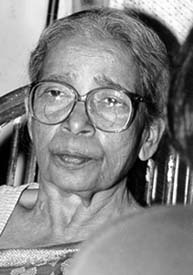
Writing as Resistance: The indomitable Art of Mahasweta Devi

This post was written as a guest entry for a reader's words, the blog of the perceptive and literary-inclined Bhupinder Singh.

Writers are often cited as perceptive observers of the prevailing human condition. Some of the greatest writers have used the power of their written word to bring across the struggles and sufferings of the exploited before a wider audience. There exists a small section of writers, however, which feels compelled to act as more than mere spectators and reporters of the human condition. They throw themselves into the fight, as it were, of deprived people.

This trailblazer of a writer is arguably the finest example of activist writers in India. For more than a quarter of a century now, she has been actively working with tribals in certain Indian states. She fights for their basic rights, helps them unite and become self-reliant, and writes about their life, often reduced to a sub-human level by the rich and powerful. A prolific writer, most of her recent work draws from her association with these marginalized communities.

The Person:

Mahasweta was born in undivided India in 1926, about two decades before India’s independence. The daughter of Manish Ghatak, a poet and novelist, and Dharitri Devi, a writer and social worker, Mahasweta probably had literary activism in her genes. It was community service that emerged on the scene before writing, though. As a college student, Mahasweta joined her friends for providing relief to the victims of the infamous man-made Bengal famine (1942-44). They would distribute food, check through dead bodies lying in street to reach out to those still alive, feed them and take them to relief centres. This direct, raw brush with suffering became the seed of Mahasweta’s empathizing disposition.

Marriage came early, at the age of 20, when she tied the knot with Bijon Bhattacharya, a renowned Bengali playwright. Her husband was also a member of the Communist Party of India (CPI), and at the time the couple was establishing its marital life, communists often became the targets of persecution. As a result, it became tough for Bhattacharya to support his family, extended with the birth of their son, Nabarun, two years after their marriage. Mahasweta did several odd jobs to keep the hearth burning—selling dye powder, supplying monkeys for research to the U.S., teaching at a school, private tuitions—before she finally got a government job at the Post and Telegraph department. But this job was not to last for too long either. Someone dropped a few books of Marx, Lenin, and Engels in her office drawer, and Mahasweta was terminated on the charge of being a communist.

The Writer:

This is when she took to the pen—mainly to supplement family income. She started with light fiction for literary magazines. Her first book-length work appeared in 1956. Jhansir Rani or The Queen of Jhansi was a fictional account of the life of Lakshmi Bai, an Indian woman ruler who valiantly led her forces to fight the British, before being killed by them at age 22. Even as a first-time author, Mahasweta showed the impractical sincerity that distinguishes true writers of historical fiction. She borrowed money from family and friends to travel to the Bundelkhand region in north India, where Lakshmi Bai ruled, and walked her way through remote villages and deserts, collecting oral history, folklores, and ballads. Interestingly, this same seriousness of approach in collecting data for her stories would be seen years later, during the activist phase of her life.

The debut book brought Mahasweta recognition as a writer, and thus started her ascent in the world of Bengali literature. She authored several books, adding the pennies toward sustaining her family, while at the same time mirroring the prevailing social atmosphere. This promising writer went through a period of personal turmoil, during which time her marriage broke apart, and she suffered from acute depression. Bouncing back soon, she completed her master’s degree in English and served as a lecturer of English literature for two decades. This was also the period when she came up with her seminal novel, Hajar Churashir Ma (The Mother of 1084), which deals with the Naxalite movement in West Bengal that saw many young lives ending before their prime. The book captures the sad realities of the movement through the eyes of the mother of one such young boy. In her attempt to understand the violent movement, this mother comes face to face with her sense of estrangement from the double standard-ridden bourgeois society to which she belongs. Poignant, yet shorn of overt sentimental elements, the novel made a big impact on readers across India and was recently taken to the silver screen by director Govind Nihlani.

The Activist:

Over the next few years, Mahasweta’s pen took a decisive turn. She started integrating history into her storytelling. This wasn’t the conventionally disseminated history though; this was forgotten history, a part of the past that had been conveniently kept under the wraps. She wielded the power of narrative to document as well as spread stories of tribal resistances against the British and other social exploitations in books such as Aranyer Adhikar (Right to the Forest), and Chotti Munda O Tar Teer (Chotti Munda and his Arrow), among others. Here was a writer who truly wrote what she knew. Her vocation wasn’t divorced from her writing. She is amongst the foremost activists working for a better life for India’s tribals. Not content to stay cosy within her writing room, she ventured deep into the forests to live and work with tribal people.

She founded India’s first bonded-labour organization in 1980, bringing together thousands of bonded labourers to give them an organised platform for raising their voice against forced labour. A year before this, she turned Bortika, a literary periodical edited by her, into an open forum in which tribal people, peasants, factory workers, and rickshaw pullers wrote about their day-to-day experiences and problems.
This effort of hers is groundbreaking, since it records the issues of the underprivileged in their own words, unadulterated and unadorned. She went on to create a tribal welfare society for the Kheria and Shabar tribes, which are among the poorest in India. In 1986, this untiring champion of the voiceless founded the Adim Jaati Aikya Parishad or Ancient Tribes Union, a forum of 38 West Bengal tribal groups.


Nine years ago, at 71, Mahasweta received the Ramon Magsaysay Award for “her compassionate crusade through art and activism to claim for tribal peoples a just and honorable place in India's national life.” While accepting the award, she said, “I will have a sense of fulfillment if more and more young writers took to unbeaten tracks. My India still lives behind a curtain of darkness. A curtain that separates the mainstream society from the poor and the deprived. But then why my India alone? Cannot one say the same for so many countries and societies today? As the century comes to an end, it is important that we all make an attempt to tear the curtain of darkness, see the reality that lies beyond and see our own true faces in the process."

Images:
Delirium
The Hindu
Sunil Janah's Site


, , ,

Tuesday, September 26, 2006

Holiday Preparations by Rabindranath Tagore

Kaash Flowers

Puja holidays come near.

Sunshine is draped in the colour of Champa flower.

The air ripples with dew,

Shiuli's fragrance touches

like the delicate caress of someone's cool hands.

The sky is lazy with white clouds—

seeing which, the mind doesn't feel like working.


Mastermoshai continues to teach

the primitive story of coal.

Sitting on the bench, the boy paddles his feet,

sees images in his mind—

The cracked ghat of Kamal pond,

And the fruit laden custard apple tree of the Bhanjas.

And he sees in his mind's eyes, the zigzag path

that leads from the milkmen's neighbourhood

by the side of the haat,

into the tishi fields, next to the river.


In the economics class at college

the bespectacled, medal-winning student

jots down a list

which recent novel to buy

which shop will give in credit—

the sari with the "Do Remember" border,

shakha washed in gold,

a pair of red velvet chappals, handcrafted in Dilli

and a silk cloth-bound poetry book,

printed on antique paper—

can't remember its name yet.


At the three-storied house in Bhabanipur

a menagerie of shrill hoarse voices talk—

This time will it be Mount Abu or Madurai,

Dalhousie or Puri,

or that ever familiar Darjiling?


And I see, on the red path that leads to the station

five or six lambs tied with ropes,

their helpless cry spreads across

the calm autumn sky that lilts with the brushing kaash flowers.

How do they understand

their puja holidays are nearby?


Mastermoshai = Respectful term for teacher (Bengali)

Ghat = Bank

Haat = Weekly village market

Tishi = Linseed

Shakha = White bangle made of a particular stone. Is worn by married Bengali women.

Chappal = Footwear


Translated by: Bhaswati Ghosh


, ,

Wednesday, September 6, 2006

PAGLA DASHU (Crazy Dashu) -- II, By Sukumar Ray

Missed Part I? Read it here.

The Deeds of Dashu (continued)

On one occasion, just after the vacations, Dashu came to the school with an intriguing box. Master Mashai asked him, "What's in that box, Dashu?" He replied, "My things, sir." A little debate ensued among us regarding the nature of his "things." We noticed Dashu had all the essential school items with him--books, notebooks, pencil, blade. Then what "things" was he talking about? When we asked him, he didn't give a direct reply. Instead, he clutched the box to his chest and said, "I am warning you all. Don't ever mess with my box." Then, he opened the lid slightly with a key and peeked inside while mumbling some calculations. The moment I tried to lean over to catch a glimpse, Dashu locked it up.


Soon, this became a hot topic of discussion for the rest of us. Someone said, "It's his lunch box. He must be hiding food inside it." But I never saw him opening the box during lunch time to eat anything. Some suggested, "It could be his money bag. It must contain a lot of cash. That is why he never parts with it." To this, another boy said, "Why such a big box to keep money? Is he planning to open a money-lending business in the school?"

During lunch one day, Dashu hastily gave me the key to the box and said, "Keep this with yourself, make sure you don't lose it. If I get a little late in returning, please hand over the key to the watchman before you all go to the classroom." With that he went away, leaving the box with the watchman.

We were thrilled! After so long, we had an opportunity; now only the watchman needed to move away for a while. Shortly, the watchman lit his stove to make rotis* and went to the water tap with a few utensils. This was just the moment we were waiting for. Five-seven of us boys bent over the box. I opened it and saw a fat bundle of papers rolled tightly with tattered cloth strings. Quickly opening the knot, we found another paper box inside, which in turn carried yet another small paper bundle. On opening that, a card popped out. One side of the card said, "Eat a green banana,"^ while the other side had the words "Excessive curiosity is not good." We started exchanging stupefied glances with each other. At last someone said, "The lad sure took us for a ride." Another boy said, "Let's tie it up exactly the way it was, so he doesn't have any inkling that we'd opened it. That would teach him a lesson, all right." I said, "Fine. When he returns, you all politely request him to open the box and show what it contains." We quickly wrapped up all the papers with strings and dropped the bundle inside the box.

I was just about to lock the box when we heard a thunderous guffaw. That's when we saw Dashu, seated atop the boundary wall, laughing insanely. The buffoon was actually watching the whole show from a vantage point. We realised the entire chain of events--giving me the key, keeping the box with the watchman, making an excuse of going out at lunch--all these were part of Dashu's prank scheme. He had been carrying that box for all these days just to make us appear like idiots.

Is it without any reason that we call him Crazy Dashu?

* Roti = Indian flat bread
^ Eat a green banana = In Bengal, this phrase is used to mildly snide effect, after fooling someone or to indiacate that a person's wish isn't going to be granted.


[The End]

Translated by: Bhaswati Ghosh


, , ,

Monday, September 4, 2006

PAGLA DASHU (Crazy Dashu) -- I, By Sukumar Ray

The Deeds of Dashu

In our school, there was hardly anyone who didn't know Crazy Dashu. Even those who knew nobody was familiar with
Dashu. One time, a new watchman came to our school; he was totally rustic. No sooner than he heard about Crazy Dashu, had he identified him. That's because from his looks, speech, and movement you could tell Dashu was a bit off in the head. He had big round eyes, unnecessarily long ears, and a scrub of scruffy hair. Whenever he walked fast or spoke in a busy manner, it reminded one of lobsters for some reason.

Not that he was foolish. When it came to arithmetic, especially complex multiplication and division problems, his brain worked rather well. Again, there were occasions when he reveled in duping us with such well-forged plans, that we were left embarrassed and stunned.

At the time Dashu or Dasharathi joined our school, Jagabandhu was famous as the "best boy" of our class. He was good in studies no doubt, but we hadn't seen a jealous wet cat like him. One day, Dashu approached Jagabandhu to ask him the meaning of an English word. Jagabandhu snapped at him without any reason, saying, "Do I have nothing better to do? Today I will teach him English, tomorrow I'll have to help someone else with maths, the next day another one would come to me with a new request. And I'd just go on wasting time on this!" A livid Dashu replied, "Hey, you are such a petty little rascal." Jagabandhu complained to Pandit Mashai, "That new boy is calling me names." Pandit Mashai* gave Dashu such a yelling that the poor fellow just went quiet.

Bishtubabu taught us English. Jagabandhu was his favourite student. While lecturing, whenever he needed to refer to the textbook, Bishtubabu would get it from Jagabandhu. One day, while teaching us grammar, he asked Jagabandhu for the book. Our friend immediately handed him the green-cover-wrapped grammar tome. As he opened the book, Master Mashai^ asked grimly, "Whose book is this?" Broadening his chest in pride Jagabandhu said, "Mine." Master Mashai said, "Hmm, is this a new edition? The entire book has changed, I see." With that, he started reading, "Hair-raising detective tales of Inspector Jashobant."

Unable to understand whatever was happening, Jagabandhu just froze, flabbergasted. Master Mashai rolled his eyes devilishly and said, "So you are learning such higher things, haan?" Jagabandhu tried to mutter something, but Master Mashai cut him short and said, "Just shut up now. No need to act nice and good. Enough of that!" Jagabandhu's ears went red with shame and insult, and we sure were delighted to see that. Later of course, we learned that this was the handiwork of brother Dashu, who had replaced another green-cover book with Jagabandhu's grammar book.

We always poked fun at Dashu, often ridiculing his intelligence and looks, right in front of him. I don't recall him getting upset about it even once. A lot of times, he would colour our comments and make up funny stories about himself. One day he said, "In our neighbourhood, whenever someone makes dry mango candy, I am in big demand. Can you guess why?" "Why?" We asked, "Do you relish mango candy?" He said, "Oh no, that's not the reason. You see, when they spread the candy for drying on the terraces, I go there and show my face a couple of times. That's enough to drive all the crows away from the area. So no one needs to guard the mango candy while it dries."

* Pandit Mashai = Respectable term for teacher.
^ Master Mashai = Respectable term for teacher.

Enjoyed? Read Part II here.

Translated by: Bhaswati Ghosh


, , ,

Wednesday, August 30, 2006

Making Sense, Nonsensically: Sukumar Ray

As the AW Chain Ship (see sidebar) sails its way through the fifth round, it's landed at my dock after crossing BK 30's harbour. BK wrote about how you can never trick her into exercising or dieting, unless you mask those evil things as something else. Makes complete sense to me. Her post is hilarious. If you are in need of a laugh, go read it.

I admire people who can make you laugh with their writing. It requires a special skill and the ingenuity to view the world in a skewed manner. Writers who trigger a tickle in the funny bone time and again are, in my view, geniuses. And no, I don't use that term lightly. The writer we meet today is a master of those funny missiles. He is the versatile, uproarious, and nonsensical Sukumar Ray—Bengali literature's very own Lewis Carroll.

I am so glad I learned reading Bengali as a child. Otherwise, I would have been denied the magic of this master of nonsense. My first brush with his strange worldview took place when I was a toddler. That was around the time I was made to learn by heart some poems from Abol Tabol or Gibberish, Ray's repository of nearly 50 balderdash verses. I didn't hate memorizing these poems; if anything, the converse was true. To the innocent and unbridled mind of the little me, such weirdness was delicious and worth getting serious about.

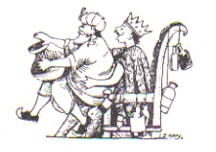
For, who would not delight to learn about the activities of the royal folks and subjects of Bombagarh, a fictitious kingdom, where the king keeps dried mango candy framed on his walls, the queen roams around with a pillow tied to her head, the citizenry does cartwheels on catching a cold, the king's aunt plays cricket with pumpkins, and the minister beats an urn while sitting on the king's lap?

In Gaaner Gunto or Musical Knock, he talks about the voice of the great Bhishmalochan Sharma—who starts singing on a scorching summer day—traveling from Delhi to Burma. People fall off and die by the dozens, unable to survive the "good vibrations" rampaging through the streets. Scores of animals fall prey to this thunderous singing session too, until a crazy goat knocks Bhishmalochan down with its menacing horns. That's when his savage vocal chords are finally laid to good rest.

Sukumar Ray becomes a child's friend in the most effortless way, just as Lewis Carroll or Edward Lear do. For here is someone who gives them the license to not only ponder on nonsense, but also to have limitless fun with it.

Ha Ja Ba Ra La or Mumbo Jumbo is a novelette peopled by strange creatures who are governed by even more outlandish rules. This complete nonsensical story is often compared to Alice's Adventures in Wonderland in style and presentation. Yet, Ha Ja Ba Ra La, which is actually a random ordering of six Bengali consonants, remains peculiarly Bengali in its idiom and rendition.

While in your childhood, Sukumar Ray and his creations entertain you as dear friends, as an adult, you begin noticing the subtle satirical undertones in his works. He takes a dig at corrupt politicians in Ha Ja Ba Ra La, pokes fun at non-laughing pseudo intellectuals in the poem Ramgarurer Chhana (Ramgarur's Offspring), and even some of the images in Bombagarher Raja insinuate the lack of activity that leads members of the royalty to find inane vocations to busy themselves with.

Over the course of the next few posts, I will introduce you to Dashu, a character created by Sukumar Ray. Be alarmed; Dashu is a bundle of surprises, accidents, and craziness. If you don't like laughing, you may not be interested in knowing about him. But otherwise...stay tuned!

And now, keeping this a strictly funny business, may I anchor the AW Chain Ship at Andrea's port, situated in the charming town of Southern Expressions.

Note: Illustrations by Sukumar Ray

, , , , ,

Tuesday, July 4, 2006

The Path to Walk on, by Rabindranath Tagore

This, indeed, is the path to walk on.

It has wound its way through the woods to the fields, through the fields to the riverbank, next to the banyan tree; then it courses its way through the villages. As it moves further, beside the lush fields, amid the shadows of the mango orchards, by the bank of the Padma River, I cannot tell in which village it would wind up.

So many people have passed by me on this path, some joining my company, others seen from afar; some with a veil over their heads, others without any; some walking to fetch water, others returning with water.

II

The day has retreated and darkness descends.

Once this path had seemed personal, intimately mine; now I see I carried a summon to walk on it just once, no more.

Past the lime trees, the pond, the riverbank, the cowsheds, the paddy mounds, the familiar glances, the known words, the acquainted circles, there won't be any returning to say "Hey there!"

This is the path to walk on, not one to return from.

This hazy evening, I turned back once and found the path to be an ode to many a forgotten footstep, all entwined in the notes of Bhairavi.

This path has summarized all the stories of all its travelers in a single dirt trail; the one track that traverses between sunrise and sunset, from one golden gate to another.

III

"Dear walking path, don't keep all the stories you have accumulated through the ages tied quietly into your dust strand. I am pressing my ears against your dust, whisper them to me."

The path remains silent, pointing its index finger toward the dark curtain of night.

"Dear walking path, where have the worries and desires of all the travelers gone?"

The mute path doesn't talk. It just lays down signals between sunrise and sunset.

"Dear walking path, the feet that embraced your bosom like a shower of wildflowers, are they nowhere today?"

Does the path know its end—where forgotten flowers and silent songs reach, where starlight illumines a Diwali of resplendent pain.

Translated by: Bhaswati Ghosh

,