Showing posts with label Guest Blogs. Show all posts

Thursday, August 26, 2010

Guest Blog: Supriya Kar

Problems of Translation -- II

This post is a continuation of
Ms. Supriya Kar's previous post. She is doing her PhD in literary translation. Her research focuses on autobiographical writings of women from the Eastern Indian state of Orissa. Here, she discusses various problems of translation, particularly in the context of her work.

Read Part 1 here


Songs in Oriya:

The songs and chants in Oriya are marked by lyricism and onomatopoeic qualities and have therefore been left untranslated. These give a feel of the sound of Oriya. The examples include:
Hare Krushna Hare krushna, krushna krushna krushna hare hare
Hare Rama hare Rama, Rama Rama hare hare.

Chala kodala, chala kodala, patia bandhe, chhande chhande, bharide mati laal...

Kesharkunja sheja re…
Duti kara dhari hari boile kishori…
Are nauri, e ghata re nabandhe taree…
Hari haraye namo, Krishna Jadabaya namo, jadabaya, madhabaya, keshabaya namo.

Forms of Address: Chandrabhaga, Chanda, Ashoka, Abhada, Gangapani, Baula and Chandi: Terms of endearment and affection, which are used in the excerpts, have been left untranslated. These terms signify deep friendship based on love and trust. These are also given social and cultural acceptance through specific rites.

Use of Titles: Panchasakha, Bhaktakabi, Mahatma, Utkalmani: Eminent public figures acquired these titles, and came to be known through these rather than their proper names. Through repeated use these became part of their names. Although they denoted certain qualities, they were actually used as proper names. So these have been kept as such and glossed where required.

Names of Institutions: Kanyashram, Shrama Sansthan Anusthan, Dhanamani Matru Mangala Kendra, Kumari Sansad, Bakula Bana Vidyalay. Although these names denote the nature and function of these institutions they are also used as proper names. So they are kept as such and glossed wherever necessary.

Kinship Terms: Chhota Maa, Menki-nani, Andhari-Maa, Durga apa, Subhabou-bhauja, Mahi’s mother, Sushila-bhauja, Nayan-bou, Rama-bhauja, Pila-mother, Jugala Saante, Nala-da, Bhika-na, Bhula-uncle, Puri-uncle.
While translating kinship terms used in India, one has to tread cautiously between the twin extremes of ‘domestication’ and ‘defamiliarisation’. Sometimes, the English equivalents have been used and, at others, the kinship terms have been retained. As all the excerpts translated here are autobiographical writings, the kinship terms are used more often than in any other fictional genre. Retaining all the terms would have made the text loaded with unfamiliar and opaque expressions. So, at times, the relationships have been explained in the text itself, sometimes, the context makes the meaning of the terms obvious.

Conversational Style:
Attempts have been made to maintain the speech rhythms of Oriya in the translation of all the excerpts. In the translation of the excerpt from Sumani Jhodia’s autobiography, punctuation marks have not been used to retain the immediacy of her words since hers is an oral testimony.

Problems in the Source Text:
There are examples of writings in the excerpts translated here which do not really make any sense, but their meaning can only be guessed from the context. In such cases, these have been tackled in a pragmatic way.
One may mention here, Arthur Lindsay’s observation that the prime duty of translators is communicating information lucidly. He goes on to submit:
As translators, our objective is to enable the reader to understand the subject matter we are translating. Hence simplicity of language is obviously the most important weapon in our armoury. Further, I submit that the more complex the subject, the greater is the need for plain English. Even if the author is incapable of simplicity in the source text, in the target language this duty devolves upon us, since we are those who must moderate between author and reader.

In translating these excerpts, strategies such as deletion, expansion, and addition have been adopted to achieve lucidity as far as practicable.

Friday, August 13, 2010

Guest Blog: Supriya Kar


Ms. Supriya Kar is doing her PhD in literary translation. Her research focuses on autobiographical writings of women from the Eastern Indian state of Orissa. Here, she discusses various problems of translation, particularly in the context of her work.


Problems of Translation -- I

In my thesis, twenty-four excerpts selected from autobiographical writings by women in Oriya are translated into English. Women whose lives these excerpts record hail from different social classes and milieus and their styles vary immensely. Therefore, maintaining the unique flavour of the texts and at the same time retaining a kind of uniformity and readability was a daunting task. Of course, there are elements in all these which one may find untranslatable. Translating is like cooking: it is one thing to say how a recipe is prepared and another to actually cook it. In this context, Piotr Kuhiwczak’s insightful observation assumes particular significance:

We can say that there is a clear distinction between discussing untranslatabilty and handling the untranslatable in the process of translation. For many of us, and this includes the students and diners I mentioned at the beginning of this essay, untranslatabilty is something that can be conceptualised and discussed ad infinitum. In contrast to this, translators have to deal with the untranslatable at a practical level. In a recent article, Margaret Jull Costa emphasises precisely this difference and the practical aspect of translation: ‘As a full time literary translator from Spanish and Portuguese, I suppose I can’t afford to believe in the untranslatable; it’s my job to translate everything, knowing that there might be some loss, but that there might also gain, and never giving in to that counsel of despair telling me that a translation is not a real thing, not the same thing, and definitely never a better thing.’
While translating, the aim was to translate so that the original should not lose its flavour, but be readable and enjoyable in the target language, without overloading the text with footnotes and glossaries that make it cumbersome for readers.


While translating from Oriya into English, the problems one encounters are more insidious than just finding the right word or expression. Partly, they flow from the very structure of the language. In addition, many of our descriptive words are highly onomatopoetic and thus almost impossible to render in English, as are the kinship terms and names of dishes, trees and flowers.

One can feel there is a palpable tension, which results from the pressure the source language exerts on the target language. The task of a translator is to minimise this tension as much as possible. Each and every sentence poses a problem. Inside the mind it goes on—permutations and combinations of words, struggling with the shape of each sentence— negotiating, groping for the right phrase. And yet the feeling of dissatisfaction persists.

Tenses in Oriya are organised slightly differently than in English. Although on paper they correspond, their boundaries do not quite map onto each other. This is because time conventions differ in different societies. The present is a much more elastic concept in Oriya than in English. That is why most Indians use English tenses wrongly. Common errors are the use of past perfect for simple past (‘I had done’ instead of ‘I did’) because Indians instinctively feel that simple past is not strong enough to indicate that something happened before now. They also use present continuous (I am doing) for simple present ‘I do.’ These problems exist across Indian languages. The problem is that while translators may be technically correct when they translate an Oriya literary text into an English present tense narrative, they are not being true to the precept that the target text should have validity as a work of art in its own right. It is bewildering to read a text translated into present tense, especially as somewhere down the line it tends to seep back into past tense.
There is a sprinkling of words connected with the physical reality of Orissa in these autobiographical writings. The list of such phrases, culture specific terms, which have been kept as such is provided below with explanations, where necessary:

Currency: adhala, pahula, ana. There is no corresponding currency in English.
Quantity: bharan, khoja, pa. These are ancient units of measurement and sometimes used idiomatically.
Slangs, Tongue-in-Cheek Expressions: chhatari, Bolibe jati sange eka ramani. There is no corresponding slang for ‘chhatari’ which is used derogatorily and abusively to mean a woman of loose morals. Literally, it means one who begs for food at chhatars or charity kitchens.
Bolibe jati sange eka ramani: People would say that one holy man is accompanied by a young woman. But the meaning of this tongue-in-cheek expression would lose its resonance if the original does not accompany its English translation.
Lunar Months: Bhadrav, Ashwina, Kartik, Margashira. A Lunar month corresponds to the period between one full moon to the next full moon. The lunar calendar is followed in observing festivals, as it is believed that the movement of the moon has a decisive influence over the affairs of human beings.
Food: ladu, badi, puri, malpua, mohanbhoga, khechudi, arisa, pura. Referring to these as delicacies or sweets would take away their cultural specificity.
Caste: karana, khandayat, chamar, radhi. The caste of a person signified his/her occupation, social status etc. These are also associated with notions of purity and pollution. The concept of caste is so quintessentially Indian that while translating Indian literary texts one has no option but to retain terms denoting caste.
Art: champu, jatra, patta. These words denote forms of fine and performing arts in Orissa, and do not have any English equivalents.
Religion: agni-pariksha, tulsi, triveni, pratah smaramy, mahamnatra, dhama, mahaprasad, mansik, homa, darshan, ashram, kathau, kirtan, akash-dipa, chaura, Amrutayana, Harinama, Ramanama, Ramdhun. These refer to religious practices which are rooted in Indian culture and their full significance can not be conveyed through English equivalents. They have therefore been retained in the translation and glossed where necessary.
Rituals and Social Practices: sholamangala, dashaha, hulahuli, haribola, shradha, ekadashi, purdah, ana-tutha, padhuan. These practices are typical of Oriya culture and so have been kept as such and glossed wherever necessary.
Festivals: Festivals such as Kumar Purnima, Raja, Kartik Purnima, Bali Trutiya underline the singularity of the cultural and religious practices prevalent in Orissa. Each festival is rooted in a specific narrative and has mythical associations. These are retained as such.

To be continued...

Image courtesy: http://www.icilondon.esteri.it/IIC_Londra/webform/SchedaEvento.aspx?id=211

Saturday, December 23, 2006

Guest Blog - Lisa Jordan

Christmas is upon us. As the festivities and merry-making envelop our senses, Lisa Jordan, Christian fiction writer, reflects on her genre, and how her faith has shaped her writing. Let us join her as she brings us closer to...


A Cradle for a King

Travel over two thousand years ago with me to a little town called Bethlehem. Our imaginary journey takes us to a stable where a tired husband and his wife, heavy with child, had been denied room at the inn. An ordinary woman has given birth to an Extraordinary Child. Instead of being surrounded by family and well-wishers, she and her carpenter husband have been greeted by noisy, smelly livestock. A feeding trough cradled their newborn Child. A cradle for a King. Such lowly surroundings for the Prince of Peace. Mary’s life has changed dramatically since the day the angel proclaimed her destiny. What went through her mind as she hugged this tiny infant to her breast? She was an ordinary woman whom God used for His extraordinary Purpose.

I’m honored to be a guest on Bhaswati’s wonderful blog. She invited me to share with her readers what it means to be a Christian fiction writer. The Christmas season is a glorious time for Christians, but as a Christian writer, it is also a wonderful time of reflection for me. God’s gift of His Son is the root of Christianity. Without His birth, my faith as I know it wouldn’t exist. Because of that faith, I have chosen to write Christian fiction.

Christian fiction glorifies God and promotes Biblical principles. The characters in Christian fiction stories are Christians or they have come to accept Christ as their Savior by the book’s end. Christian fiction novels and stories have a spiritual element woven into the plot. The characters rely on God to help them through their situations. The books are wholesome with no swearing, no premarital sex, or graphic content.

Christian fiction characters endure real life situations and writers of Christian fiction novels use realistic, and sometimes, edgy themes, such as abuse, adultery, addiction, child pornography, prostitution, rape. Christian fiction genres are broken into many of the sub-genres as secular fiction, such as romantic suspense, chick-lit, romantic comedy, women’s fiction, thrillers, science fiction/fantasy.

Some of my favorite Christian authors include Susan May Warren, Colleen Coble, Deborah Raney, Kristen Billerbeck, Diann Hunt, Trish Perry, Dee Henderson, Judy Baer, Allie Pleiter, Debra Clopton. There are many more. These women write in different genres, but they share the love of Jesus and their novels reflect their faith.

I’ve known I’ve wanted to be a writer since I was sixteen years old. Through the years, I’ve penned stories that will never see the light of day. However, each of those stories has taught me valuable lessons about how to develop three dimensional characters, setting, plot, conflict, etc. Even published writers will say they never stop learning. By listening to constructive criticism and accepting advice from other knowledgeable writers, I’m striving to write a novel that will catch an editor’s attention.

Belonging to reputable writing organizations has helped me hone my craft. I’m a proud member of American Christian Fiction Writers, the premiere organization for Christian fiction, and Faith, Hope & Love, the inspirational chapter of Romance Writers of America. I’ve had the opportunity to attend two ACFW conferences. Both have been vital in helping me understand the complex craft of writing.

Writing Christian fiction is a ministry. It is my desire to combine my faith with stories of my heart to touch the hearts of women who may read my future novels. I write Christian women’s fiction novels about ordinary women who are extraordinary in God’s eyes. After all, I have years of experience of being an ordinary woman, but I believe in an extraordinary God. I invite you to visit my website.

As the holidays approach, take a break from the shopping, the baking, the parties, the gifts, and remember Jesus is the reason for the season. Merry Christmas. May God’s blessings be abundant throughout the New Year!

Wednesday, November 1, 2006

Guest Blog - Cesar Puch

Cesar Puch dons numerous hats and does so with élan. Horror writer, programmer, webmaster, art director, and very recently, editor. Shadow Regions, an anthology of twilight zone-ish horror tales, edited by Puch, is now available. In this post, Cesar takes us on…


A Stroll Down the Dark Path of Horror Writing

A short while ago my good friend Bhaswati mentioned she wanted to invite a few of her acquaintances to write some guest posts in her blog and that she wanted me to do one of those. I told her I was definitely interested and I asked her if there were any “guidelines” before I went ahead with my post. “Actually, there is something,” she said then, and mentioned her interest in a theme that’s very close to me, a theme that brought some questions to her mind.

I write horror. As many of you might know, our Sury’s (Bhaswati's) writing goes in a totally different direction, yet she always wonders… We’re the best of friends, even when she is in India and I’m in Peru, we share a lot together and one thing she commented once was how someone she considers to be “so nice” (her judgement, lol) could come up with stuff that can be pretty dark.

I don’t know if I’m nice or not, and I do believe everyone has a shade of darkness within, huge or tiny that varies. It is what makes us humans after all. I do like to think of myself as “a good person”, I stick to myself, I try to be respectful to others, and I try to play devil’s advocate whenever there’s a discussion just to try to grab all the dimensions in a problem… But yes, darkness is familiar to me. So why choose that? Why write horror? How can an apparently happy, nice, good person by society’s standards come up with stuff that makes us cringe? Does it take a toll? Let’s try to answer these questions.

Many years ago horror novelist Stephen King wrote a book called “The Dark Half”. In it, Thad Beaumont, a literary writer makes money and fans on the side by writing gore with the byline of George Stark. Stark is not only a name on a page, but has been even given a “past” as a violent ex-con now living in a self-imposed exile. When Thad makes the decision of “killing off Stark,” the fictitious Stark materializes and comes “back from the death” to claim vengeance on the editor, the publisher, and ultimately on Thad—the people responsible for his death. In doing so, Stark appears as murderous as the characters in his gory novels.

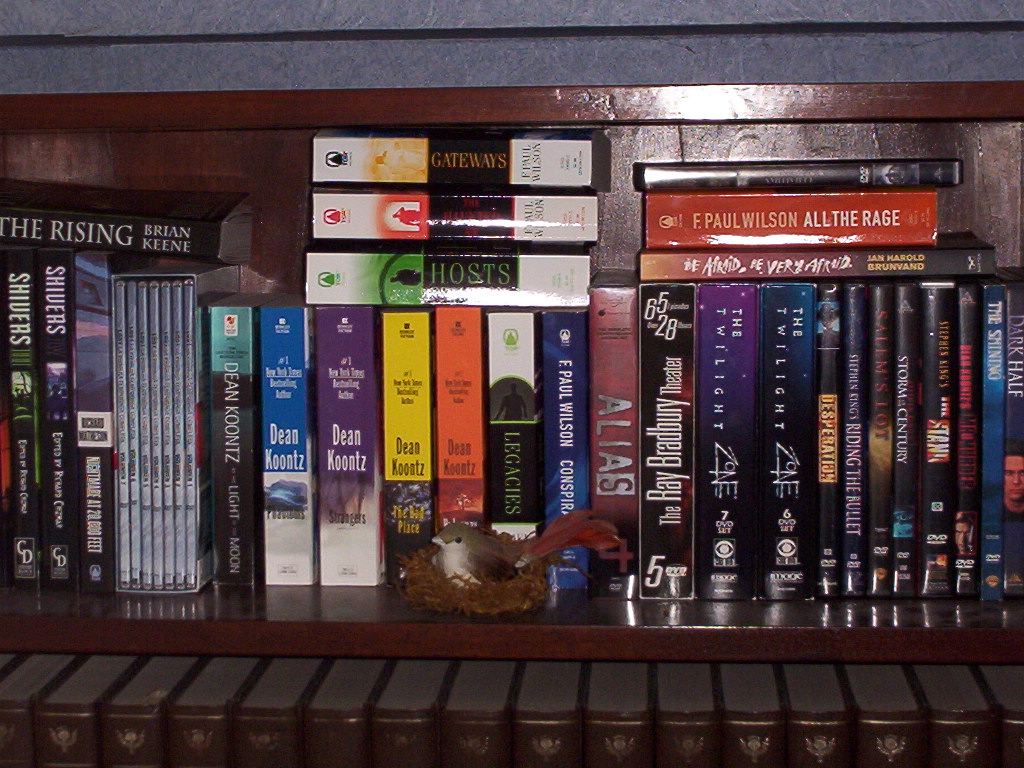
Are all horror writers like George Stark? OK, forget the murders (or not … :-s) but are all horror writers dark people who dwell on violence and blood, who have a twisted view of the world, who surround themselves with the goriest props and who have a shrine at home for Friday the 13ths Jason Voorhies? The answer is… ok, maybe some, in greater or lesser degree. But for the most part, we are talking about family people, very respectful, very friendly. I’ve had the chance to meet a few horror authors who turn out to be really nice people to deal with. I recently started reading a novel called The Rising, a very gory, very acclaimed book about zombies by author Brian Keene. The first thing I read was the dedication: “For David, Daddy loves you more than infinity”. Not quite the axe-wielding lunatic, huh?

Personally I’m not a big fan of gore (for those who don’t know gore implies stuff like running blood, spilling bowels, decapitations, and other gruesome stuff, the more gruesome the better, at least for fans). I am a true fan of The Twilight Zone and stories that, as I said in the introduction to my anthology Shadow Regions, scare you in the mind, not in the gut. I like the psychological aspect of horror, the supernatural part of it. However, during my experience as a writer, I inevitably dealt with pretty hard stuff: rape, violence, child abuse, pedophilia, death of loved ones, teenage sex and drug use, murder, etc. You see, before writing about sadistic killings, I prefer writing about (sadly) very real stuff. Is that hard to do? Yes, sometimes it is. But when you write horror you just do it.

I’m sure writing tough subjects are a part of every genre in fiction. Does it keep us away from going back to the keyboard? Not really. Why? Hard to tell. One thing is clear though. Our writing, at least mine, is in no way a celebration of these terrible things, but they are inevitable for the plot moving forward.

And what about the not so real but oh so terrible other stuff? The supernatural bit? Why that? I can’t answer for other authors and their choice of the amount of gore and supernatural elements they put in their work. For me, the supernatural has a charm of its own. It pokes at my sense of wonder. It takes me away from a world where things are bound to happen into another where even more things are bound to happen, in ways I never thought possible.

I used to be a scaredy-cat when I was little. I don’t know when that changed, when I took a step inside that darkness. But I believe I didn’t go in without a few lifelines. I do like to think I keep a solid line traced between what’s fiction and what’s real, even if one mirrors the other. I do like to think that the horror I write is not a direct reflection of me, but a sort of catharsis. Once I talked to a friend of mine—who happens to be a psychologist—about eros and thanatos (good and evil), how we all have some of both within ourselves. She said, in my case I was sort of recycling thanatos and turning it into eros, creation.

So why do I write these hard things? Here’s a simple-minded answer: I’d rather see them on page than in the real world.

I write creepy stuff, I generate scares for people who want to be scared, excited, chilled for a bit before returning to their everyday lives. Readers come in all shades and colors. Some want that jolt, be it just a little shock or a massive discharge. And for those readers there will always be the authors who provide those jolts. Those people are not the potential serial killers some would think. They just approach fiction in a different way.


Friday, August 11, 2006

Guest Blog - Bhupinder Singh

At Home, Writing is pleased to welcome its wonderful readers to the first Guest Blog. I am excited at the opportunity to learn from the perspective of fellow bloggers. I hope you all would enjoy interacting with these discerning guests too.

We begin with Bhupinder Singh's review of:


Santa Evita
By: Tomás Eloy Martínez

In the short span of six years between 1946 to 1952, Eva Perón, the wife of the Argentinean dictator and founder of the Perónist party, Juan Perón, won over the Argentinean people so much so that her popularity was said to rival, if not exceed, that of Juan Perón himself. Having risen from obscurity, the youngest daughter of an unwed mother, her rise had been all the more spectacular.

Tomás Eloy Martínez's Santa Evita could have been termed as a biographical account Eva Perón's life had the author chosen to write about her short but eventful life.

Instead, he has chosen to write about her corpse.

Eva Perón's body, like Lenin's, was embalmed after she died of cancer at the age of 33, at the height of her popularity. However, before the corpse could be housed in a mausoleum for public display, Juan Perón was overthrown in a military coup, and thus began the after- life journey of Eva Perón, as the incumbent military government wondered what to do with the embalmed body.

To bury the corpse could have, they feared, incited the loyal Perónists and even the masses. And Eva dead was perceived as more dangerous than the living one.

Even a few replicas were created to mislead any followers, and attempts were made to bury them. For over a decade, the corpse and the replicas changed hands and locations, traversing within Argentina and to Europe- one replica was buried in Bonn and the actual corpse in Milan, Italy from where it was finally recovered and returned to Juan Perón after his return from exile in Spain.

Martínez recounts the stories of all those that came in contact with the corpse, and the often calamitous ends that they came to. Insidious accidents awaited those entrusted with the corpse.

Some were haunted till death, some met with inexplicable accidents and others were relentlessly followed by a mysterious person called the 'Commander of Vengeance'.

It is characteristic of Martínez to write a novel that takes the after- life of Eva Perón rather than her not less eventful life as its theme. He does show us slices of her life too, but often as flashbacks and in recollections of those that he meets with.

In a sense, therefore, he underlines the persona that outlived Eva Perón herself.

This is akin to his previous novel, the redoubtable The Perón Novel, where he focused not so much on Peron's politically active years, but the seemingly innocuous journey of an exiled dictator returning to his home country in old age.

Santa Evita is a novel within a non- fictional account where Martínez goes out in search of information about Eva Perón's corpse- the story emerges as he interviews people associated with Eva or later with her restless corpse.

He makes the reader an accomplice in this journey of discovery- it becomes very much like a mystery in which the reader has as many, and more often as few, clues as the writer. This makes the novel extremely readable, if not racy.

Santa Evita turned out to be unputdownable, and I finished it within a week. Along with The Perón novel, it has been one of my best reads from Latin America in the last one year.

Note: Bhupinder Singh is the author of a reader's words--a blog encompassing a wide spectrum of the literary world. From Dalit literature to Latin American authors, and from regional Indian writers to Leftist writings, Bhupinder covers it all. His blog is not limited to just books and authors, though. The subtitle--comprising keywords such as literature, left, liberal, socialism, globalization, dalit, books, Urdu poetry, south Asia, India--is indicative of the inclusive nature of his blog.

, , , , ,